What an SMS fire dialler can't tell you (and why it costs you)
An SMS dialler tells you something happened. It can't tell you what, where, why, or how often, and that gap is costing Australian buildings real money every year.
If your fire panel sends you an SMS when an alarm trips, you have an SMS dialler. It might be a 4G unit bolted next to the panel, a cellular module sold by your monitoring provider, or a feature built into the panel itself. Whatever the form, the job is the same: when something happens, push out a text message.
That's useful. It's also where most buildings stop. The dialler does its one job, the SMS lands on a phone, and everything beyond that (the context, the history, the pattern, the cost recovery) is left to whoever happens to be holding the phone at 2:14 am on a Sunday.
An SMS dialler isn't wrong. It's just incomplete. And the gap between what it does and what a building actually needs is where the avoidable costs pile up.
What an SMS dialler actually does
At its core, a fire alarm dialler watches one or more output relays on the fire panel, typically the alarm output and sometimes a fault output. When the relay changes state, the dialler triggers a pre-configured action: an SMS to a list of mobile numbers, often a phone call to a monitoring centre, sometimes an email.
The message is short by necessity. "ALARM - 12 Smith St" is about as much as you'll get. No detector ID. No zone description. No timestamp history. No idea whether this is the third time this week or the first time in a year. Just a notification that something happened, and a building address.
That's the baseline. Now look at what it leaves out.
1. No event history
An SMS arrives, someone reads it, and unless they manually log it somewhere, the event vanishes. Next week when the same detector trips again, no one connects the two. Three months later when the brigade invoice arrives, no one has the timestamps, the zone, or the panel state to challenge it.
The fire panel itself keeps a logbook, but it's local: you have to physically stand at the panel and scroll through it, and the log has a fixed capacity (typically a few hundred to around a thousand events), after which the panel overwrites the oldest entries. Reading a fire panel logbook is a useful skill, but it's the wrong place for this data to live if you actually want to act on it.
What you need instead: every alarm and every fault, on every panel, captured automatically with full context (date, time, zone, device, panel state) and searchable months later. That's what real-time monitoring means in practice. Not a dashboard you check; a record you can search.
2. No pattern detection
One false alarm is an event. Six false alarms from the same detector over twelve weeks is a pattern. Without history, you can't see the pattern. Without seeing the pattern, you can't fix the cause.
Most recurring false alarms aren't random. They cluster around specific detectors, specific times of day, specific weather conditions, specific contractor visits. We've written about the seven most common causes in detail, and what every one of them has in common is that the cause is identifiable only if you can see the pattern. An SMS dialler hands you each event in isolation. The pattern is invisible.
What you need instead: alerts that flag when the same detector or zone has fired multiple times in a short window, and a complete event timeline so you can correlate alarms with what was happening in the building. The job changes from "respond to this SMS" to "fix the cause once and stop getting the SMS."
3. Cryptic panel messages, no plain English
"ZONE 4 ACTIVATION." "LOOP 2 FAULT." "MX SUPERV LOSS." Fire panels speak their own language, and even experienced building managers often need to look up what a code means before they can decide what to do. At 2 am, in a hurry, that's a problem. For a fire warden trying to coordinate evacuation, it's worse.
At best, an SMS dialler forwards whatever cryptic string the panel produces. Simpler relay-triggered units send a fixed, pre-programmed message with no detail at all. Either way, whether you understand it is your problem.
What you need instead: alerts that translate the panel's output into plain English, telling you what's happening, where, and what the right next action is. "Smoke detector activated in the kitchen on level 3, no other zones affected" is something anyone can act on. "ZONE 4 ACTIVATION" isn't.
4. One building at a time, not a portfolio
An SMS dialler is bolted to a specific panel in a specific building. If you manage one site, that's fine. If you manage twelve, or fifty, you're now juggling a dozen separate text-message threads from a dozen separate diallers, with no shared view, no shared history, and no way to compare what's happening across the portfolio.
For building managers and facility teams running multiple sites, this is the daily reality: switching between phones, spreadsheets, and provider portals just to know which buildings had alarms last week. Every site is its own silo.
What you need instead: every panel, across every building, in one place, with role-based access so wardens see their site, contractors see the buildings they service, and owners see the whole portfolio. The dialler can't do that. It was never designed to.
5. No paper trail for cost recovery
Every Australian state charges a false alarm fee when the brigade responds and there's no fire. Fees range from around $400 in Tasmania to $2,000 for building owners in the ACT, and in Victoria, where the charge is $657 per truck per 15 minutes, a multi-appliance response can cost even more. In most states the charge can be waived or disputed if you apply on time with the right evidence. But only if you have the evidence.
An SMS dialler doesn't give you evidence. It gives you a text message. The waiver authority wants the alarm time, the cause, the response, the panel state, the steps you've taken to prevent recurrence. Putting that together from memory, weeks after the event, while a submission window as short as 14 days ticks down (Victoria, we're looking at you) is how legitimate waivers don't get filed.
What you need instead: every event captured with the detail a waiver application needs, and an automated process that drafts the waiver letter against your state's specific guidelines as soon as the false alarm happens. Turn each $400-$1,656 charge from an unavoidable cost into a recoverable one.
What this gap actually costs
Add it up across a year, in a single mid-sized commercial building with five false alarms:
- Five brigade attendance fees at, say, $1,200 average. $6,000.
- Half of those are waivable but missed because no one had the evidence in time. $3,000 left on the table.
- The recurring cause behind three of the five was the same detector, never spotted because nobody could see the pattern. Three more callouts before someone finally figures it out. $3,600 more.
- Time spent by the manager chasing logbook entries, drafting waiver letters from scratch, and coordinating contractors after each event. 10-20 hours a year.
None of that money was set on fire by the SMS dialler. It was just left on the table because the dialler couldn't tell anyone what they needed to know to act.
What real fire panel visibility looks like
The shift isn't from "no monitoring" to "monitoring." Most buildings already have a dialler. That's monitoring of a kind. The shift is from a one-way SMS to a complete picture: every event captured, patterns surfaced, alerts in plain English, every panel across every building in one view, and the cost-recovery loop closed automatically.
That's what Magnifire is built for. It works alongside your existing fire panel and ASE (we're not asking you to rip anything out) and adds the layer that diallers were never designed to provide.
How Magnifire helps
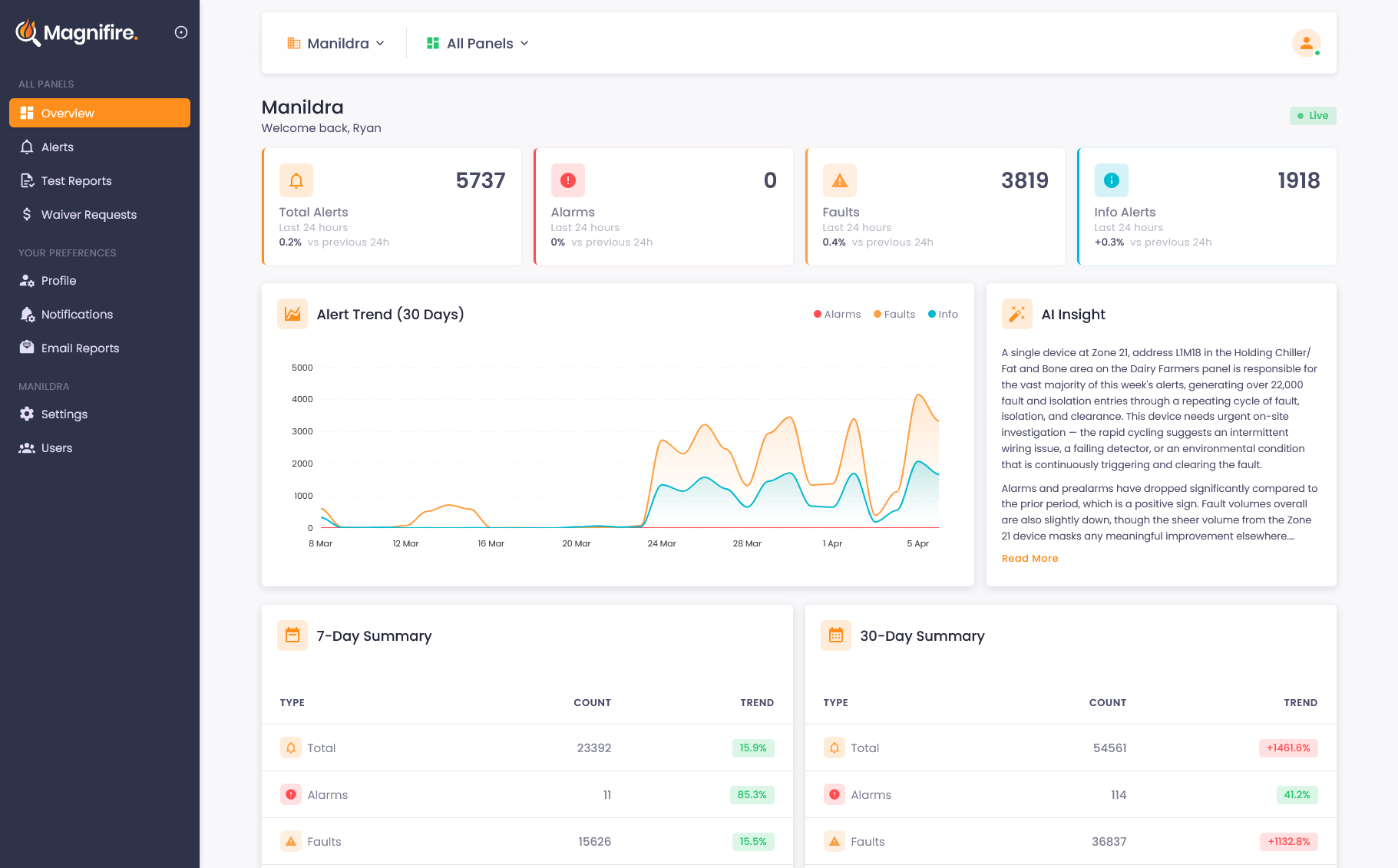
Magnifire monitors every alarm and every fault on your panels in real time, captures full event context automatically, surfaces patterns before they become recurring problems, and translates cryptic panel codes into language anyone can act on. Scheduled reports keep your team informed without anyone having to log in. When a false alarm does happen, the waiver application is drafted for you against your state's specific guidelines, with the deadline tracked.
If you manage a single building or a portfolio of fifty, the experience is the same: real visibility, in plain English, on every panel, all the time.
Book a demo and we'll show you exactly what your buildings look like through Magnifire.
Sources
- Fire and Rescue NSW: "Automatic Fire Alarms" ($1,656 false alarm charge; waiver applications accepted up to 180 days from the invoice date)
- Fire Rescue Victoria: "False alarms FAQ" ($657 per truck per 15 minutes, 2025/26 rate; 14-day window to submit maintenance records and supporting evidence)
- Tasmania Fire Service: "False Alarm FAQ" ($423 false alarm charge for 2025-26, the low end of the national range; waiver by written application to the Chief Officer)
- Johnson Controls / Tyco: Vigilant MX1-Au Fire Alarm System Operator Manual (LT0439) ("The MX1 maintains a history of the 900 most recent events... When the history is full, the oldest event is deleted so a new event can be added"; panel event log capacity and rollover)
See what you've been missing
Whether you own, manage, or maintain fire systems, the visibility changes everything. We'll show you exactly how it works for your situation.