The 7 most common causes of false fire alarms (and how to prevent them)
Most false alarms fall into a handful of predictable patterns. Here's what causes each one, and what to do about them.
A monitored fire alarm system exists to protect the building and the people in it. When it triggers unnecessarily, it doesn't just cost money. It erodes trust. Staff stop evacuating. Managers start dismissing notifications. Brigade attendance fees pile up. And the underlying cause of the alarm often goes unaddressed, because no one has the data to trace the pattern.
Most false alarms aren't random. They fall into a small number of recurring categories, and nearly every one of them is preventable, if you know what to look for. Here are the seven causes we see most often in Australian commercial, industrial, and strata buildings, with what you can do about each.
1. Cooking fumes and steam
Smoke detectors installed near kitchens, break rooms, coffee stations, or canteens frequently misread oil vapour, toast smoke, and steam as a fire event. This is probably the single most common cause of false alarms in commercial buildings with food service, and it tends to happen at predictable times of day.
What to do: relocate detectors away from direct kitchen airflow, specify heat detectors rather than smoke detectors in cooking zones, and make sure range hoods are venting properly. In many cases the fix is just moving the detector a metre or two.
2. Dust from construction or contractor work
Drilling, cutting, sanding, concrete work, and ceiling access all release airborne particulate that smoke detectors happily read as smoke. Contractor-generated dust is a leading cause of false alarms in buildings undergoing fit-out, refurbishment, or routine trade work.
What to do: isolate the affected detectors before work begins (not disconnect them), notify your monitoring provider and the brigade in advance where appropriate, and clean detectors after work finishes. Isolations should be logged and reversed when the job is done. Forgotten isolations are their own compliance risk.
3. Aerosols
Hairspray, deodorant, dry shampoo, insect spray, spray paint, and spray cleaning products all contain fine particulates that can set off a smoke detector. This shows up most often in hotels, gyms, salons, and any space where people get ready in close proximity to detectors.
What to do: consider detector types less sensitive to aerosol particles, review detector placement in high-use areas, and improve ventilation where feasible.
4. Smoking, vaping, and candles near detectors
Smoke detectors don't distinguish between cigarette smoke, vape vapour, and the smoke from an actual fire. In hotels, older apartment buildings, and outdoor smoking areas that aren't truly separated from the building envelope, this accounts for a steady stream of false activations.
What to do: proper signage, adequate separation between smoking areas and building air intakes, and, where the budget allows, detectors with pattern recognition that can distinguish vape aerosol from combustion smoke.
5. Faulty or aged detectors
Smoke detectors don't last forever. Over roughly eight to ten years, sensitivity drifts, dust accumulates inside the chamber, and insect intrusion becomes more likely. A detector that triggers repeatedly without an obvious external cause is very often just worn out.
What to do: check your asset register. If a problematic detector is approaching end-of-life, replace it rather than cleaning it again. Your fire safety contractor should be flagging these during routine service. If they aren't, ask them to.
6. HVAC-related humidity, steam, and airflow
Bathroom steam venting into corridors, humidity from pools and laundries, and airflow from HVAC pushing dust past detectors can all trigger false alarms. Airflow is often the hidden culprit: a detector that's fine most of the time fails only when the HVAC is running in a particular mode.
What to do: review detector placement against current airflow patterns (which may have changed since installation), adjust HVAC where necessary, and consider air-sampling detection for problem areas where traditional detectors struggle.
7. Manual call points
Manual call points (sometimes called break-glass alarms or MCPs) get activated by accident, by curious children in schools and apartment buildings, and sometimes maliciously. Damaged or degraded glass and incorrect placement in high-traffic thoroughfares also contribute.
What to do: install MCP covers that require a lift-to-activate action, review placement in high-risk areas, and consider CCTV coverage where malicious activation is a recurring problem.
What recurring false alarms actually tell you
When a building has six, ten, or fifteen false alarms in a year, it's almost never that many unrelated events. It's the same root cause, repeating. A detector next to a kitchen. A contractor zone that never gets isolated. A break-glass unit in a corridor that children walk past every morning.
The value of seeing those patterns isn't academic. Once you know the cause, you can fix it, and you stop paying brigade attendance fees that could have been prevented. For a building paying $1,656 per false alarm in NSW, fixing one recurring cause can save thousands over a year.
How Magnifire helps
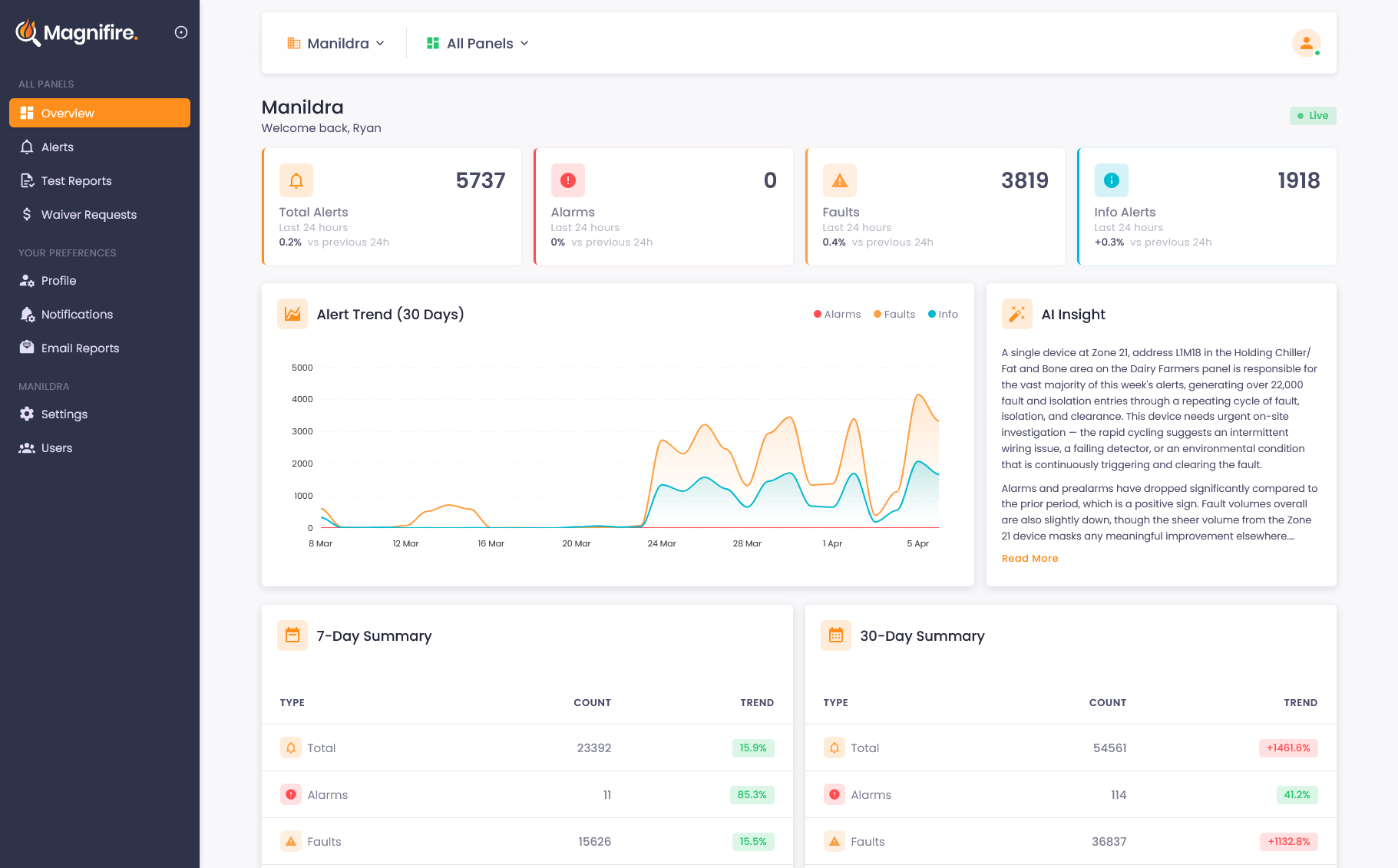
Magnifire monitors every alarm event on your panels in real time. When a false alarm occurs, the system captures the exact detector, zone, device, and timing, and flags when a pattern is emerging. Three alarms from the same detector in six weeks isn't random. Magnifire surfaces that, clearly, before the fourth one arrives.
Combined with automatic waiver letter generation when a false alarm does occur, the loop closes: fewer false alarms, lower fees when they happen anyway, and a complete event history to hand your contractor when it's time to act on the cause.
Sources
- ACT Emergency Services Agency: Fire Safety Guideline FSG-23 v2.0 (November 2025): AFA False Alarm Charges and Fee Waivers (fire authority list of the most common false alarm causes: poor maintenance, system malfunction, contractors, burnt food, cooking fumes, steam, aerosols, cigarettes/candles/vaping, dirty detectors, and break-glass damage or misuse)
- Fire and Rescue NSW: "Automatic Fire Alarms" ($1,656 false alarm charge; approximately 98% of the ~58,000 automatic fire alarm activations FRNSW attended in 2025 were unwanted alarms)
See what you've been missing
Whether you own, manage, or maintain fire systems, the visibility changes everything. We'll show you exactly how it works for your situation.