How much does a false fire alarm cost in Australia?
A complete guide to false alarm fees, waiver deadlines, and cost recovery across every state and territory.
When a monitored fire alarm activates and the fire brigade responds to find no fire, the building owner gets charged a false alarm fee. These fees range from around $400 to $2,000 per incident, and in Victoria the charge is per fire truck, per 15 minutes, meaning a single multi-appliance false alarm can cost thousands.
Most building owners and managers don't know they can apply to have these charges waived. The process varies dramatically between states, with different deadlines (as short as 14 days in Victoria), different authorities, different criteria, and different forms. Missing a deadline means paying the full amount with no recourse.
The cost of doing nothing
False alarms aren't rare. Dirty smoke detectors, contractor work generating dust, cooking fumes in commercial kitchens, insects in detector housings. There are dozens of common causes. A building with an active fire alarm system can expect several false alarms per year. At $1,656 per incident in NSW, that adds up fast.
The good news: every state has some form of waiver or dispute process. The bad news: every state does it differently.
State-by-state breakdown
Here's a summary of what each state charges and how long you have to act. Click through to any state for the full breakdown including legislation references, leniency rules, and waiver criteria.
Key things to know
Deadlines are non-negotiable. Victoria can give you as little as 14 days to respond once FRV asks for your explanation and maintenance records. NSW and ACT are more generous at 180 days from the invoice. But once the deadline passes, there's no recourse: you pay the full amount.
The process varies dramatically. NSW has 11 specific waiver criteria. Victoria uses a "reasonable excuse" framework. Queensland calls it a "dispute" not a "waiver" and requires Form OM201. The Northern Territory requires a Statutory Declaration, and the Waiver Committee's decision is final with no appeal.
Leniency rules can save you before you even need to apply. NSW doesn't charge for the first alarm in any 60-day period. Western Australia allows three free false alarms per financial year. South Australia has a 3-month grace period for new installations. Understanding these rules can mean the difference between a charge and no charge at all.
The quality of your application matters. A well-written waiver application that references the correct legislation, addresses the right authority, and includes evidence of proactive maintenance is far more likely to succeed than a generic letter.
How Magnifire automates the process
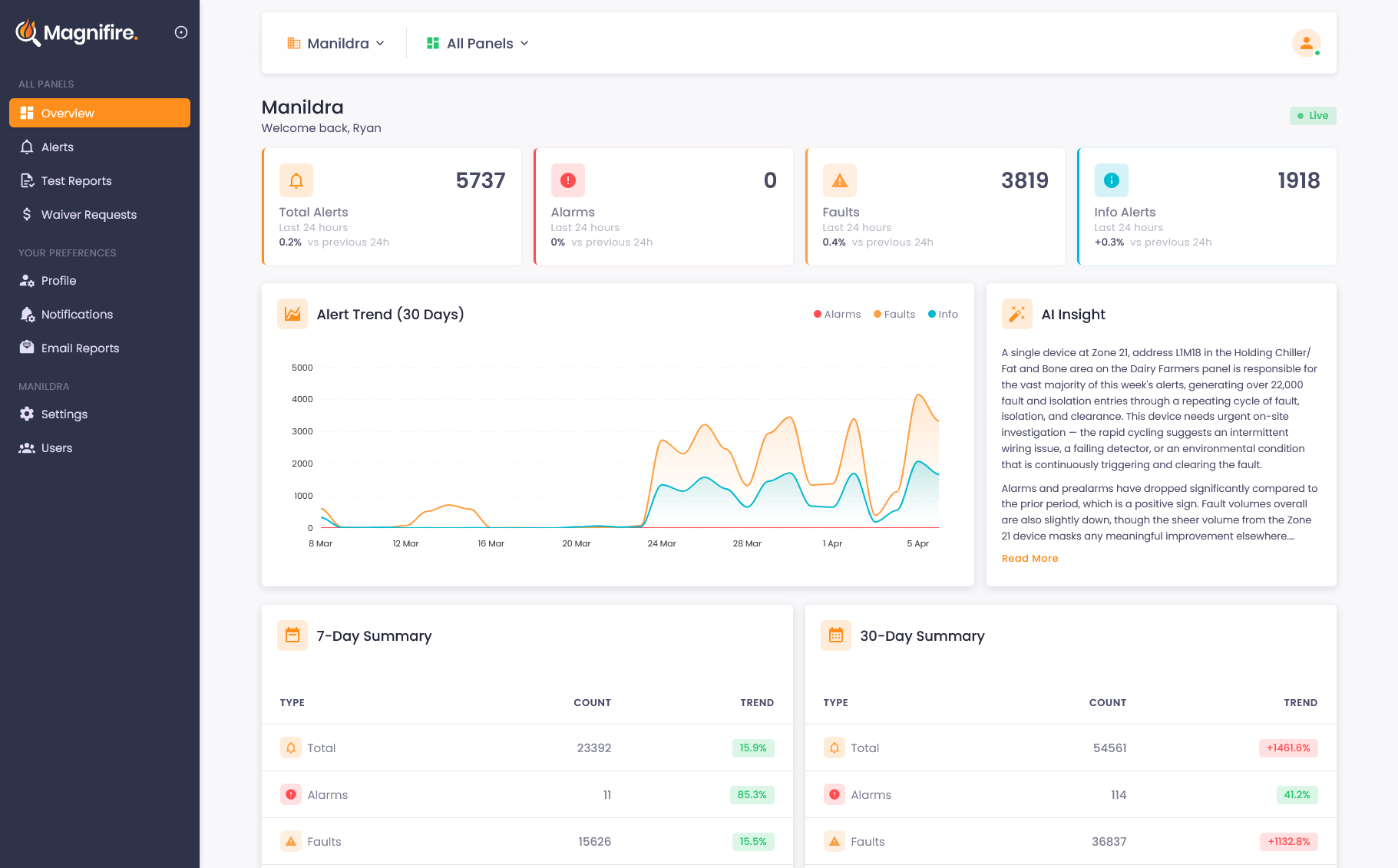
Magnifire monitors your fire panels in real time. When a false alarm occurs, the system detects it within seconds, calculates the waiver deadline based on your state, and generates a professional waiver letter using AI that understands the specific legislation, criteria, and submission requirements for your jurisdiction.
The AI-generated letter references the correct legislation, addresses the right authority, uses the appropriate framing for that state's process, and includes your monitoring data as evidence of proactive compliance with Australian Standards.
For building owners managing fire safety across multiple states, Magnifire handles the jurisdictional differences automatically, so you don't need to be an expert in 8 different waiver processes.
Sources
- Fire and Rescue NSW: "Automatic Fire Alarms" ($1,656 false alarm charge, first-alarm-in-60-days and 24-hour leniencies, 180-day waiver application window)
- Fire and Rescue NSW: Guideline No. 4: Application to Waive AFA False Alarm Charges (AFA-G-04) (the 11 waiver criteria and 75% waiver cap on rectification-based criteria)
- Fire Rescue Victoria: "False alarms FAQ" ($657 per truck per 15 minutes, 2025/26 rate; 14-day submission period for maintenance records; 28-day VCAT appeal window)
- Queensland Fire Department: "Unwanted alarms charging" ($1,556.79 per unwanted alarm under the schedule current from 1 July 2026; Form OM201 dispute lodged within 60 days of the invoice)
- Department of Fire and Emergency Services (WA): "False Fire Alarm Fee Fact Sheet" ($1,337 fee, applied only from the fourth false alarm per premises per financial year; s 36ZL(1)(d) Fire and Emergency Services Act 1998)
- Government of Western Australia: "Disputing a false fire alarm fee or notification" (applications within 21 days of the invoice or notification)
- South Australian Metropolitan Fire Service: "Unwanted False Alarms" ($471 charge, 3-month grace period for new connections, waiver applications within 30 days of the invoice)
- Tasmania Fire Service: "False Alarm FAQ" ($423 charge for 2025-26 under s 109A Fire Service Act 1979; waiver by writing to the Chief Officer, no published deadline)
- ACT Emergency Services Agency: Fire Safety Guideline FSG-23 v2.0 (November 2025): AFA False Alarm Charges and Fee Waivers (two-tier $400 occupant / $2,000 owner charging, 90-day leniency, 180-day application limit)
- NT Police, Fire and Emergency Services: "Unwanted (Inadvertent) Alarms" ($1,376 per response; applications within 30 days with a Statutory Declaration; the Waiver Committee's decision is final)
See what you've been missing
Whether you own, manage, or maintain fire systems, the visibility changes everything. We'll show you exactly how it works for your situation.