58,000 false alarm call-outs in NSW last year: here's how much of that money was recoverable
Tens of thousands of chargeable call-outs at $1,656 apiece, a published waiver process, and almost nobody applying. The question is: how much could you have got back?
In 2025, Fire and Rescue NSW responded to approximately 58,000 automatic fire alarm activations. Around 98% of them were unwanted alarms: no fire, no emergency, just a brigade rolling up to burnt toast, shower steam, or dust from a grinder. Automatic fire alarms now account for roughly 40% of everything FRNSW responds to.
Sit with that number for a second. Fifty-eight thousand call-outs. Tens of thousands of them chargeable at $1,656 apiece. And the buildings paying those invoices are, overwhelmingly, buildings like yours: hotels, aged care, apartments, warehouses, schools. If you manage one of them, some of that money almost certainly came out of your budget last year. The question this article answers is simple: how much of it could you have got back, and why didn't you?
How the NSW false alarm charge actually works
Under the Fire and Rescue NSW Act 1989, FRNSW can charge for attending false alarm call-outs generated by monitored automatic fire alarm systems (the ones with an ASE on the panel that dials the brigade automatically). The charge exists for a reason FRNSW is upfront about: it's there to motivate building owners and managers to stay proactive about managing their alarm systems and keeping them properly maintained, because properly maintained systems have been shown to produce fewer false alarms.
The current charge is $1,656 per chargeable false alarm. But not every unwanted alarm gets billed, and this is where most building managers' knowledge runs out. FRNSW applies leniencies: the first false alarm in a 60-day period is not charged, and where repeat alarms occur within a 24-hour window, only one of them is charged. It's the second, third, and fourth alarms inside that 60-day window that start stacking invoices, which is exactly what happens when a building has an underlying problem: a dirty detector, a badly located sensor, a kitchen exhaust issue that nobody has fixed.
That's the trap. The building with one freak alarm pays nothing. The building with a recurring, fixable problem bleeds $1,656 at a time. And it keeps bleeding until someone connects the invoices to the root cause.
The waiver process almost nobody uses
Here's the part that genuinely surprises most building managers: FRNSW has a formal waiver process. Under section 43 of the Fire and Rescue NSW Act 1989, the waiver or reduction of false alarm charges is at the discretion of the Commissioner, and the mechanics are set out in FRNSW's Guideline No. 4: Application to Waive AFA False Alarm Charges.
The headline rules are these. A waiver application must be lodged not more than 180 calendar days from the FRNSW invoice date. Applications go through your Automatic Fire Alarm Service Provider (the monitoring company), not directly to the brigade. The firefighters who attend on the day have no authority to waive anything, so whatever they say at the panel means nothing for your invoice. And critically, the grounds matter: alarms caused by events genuinely beyond your control, such as storms and natural disasters, aren't charged in the first place, while waivers for other alarms generally hinge on evidence that you've rectified the specific cause of the false alarm. Routine maintenance records alone (proof you've been cleaning detectors on schedule) are explicitly not considered grounds for a waiver. FRNSW wants to see that the problem that triggered the call-out has actually been fixed.
So why does almost nobody apply? Three reasons. First, most managers simply don't know the process exists: the invoice arrives via the monitoring company, it looks like a statutory fee, and it gets paid like one. Second, the invoice chain obscures the clock: by the time the charge filters from FRNSW through the AFASP to your accounts inbox, weeks of your 180 days are already gone, and in other states the windows are far tighter. Fire Rescue Victoria's submission period for supporting records can be as short as 14 days. Third, even managers who know about waivers rarely have the evidence assembled: which detector fired, at what time, what the cause was, and what rectification work followed. Reconstructing that from a paper logbook and a contractor's invoice three months later is a job that never makes it to the top of anyone's list.
What automatic waiver tracking looks like
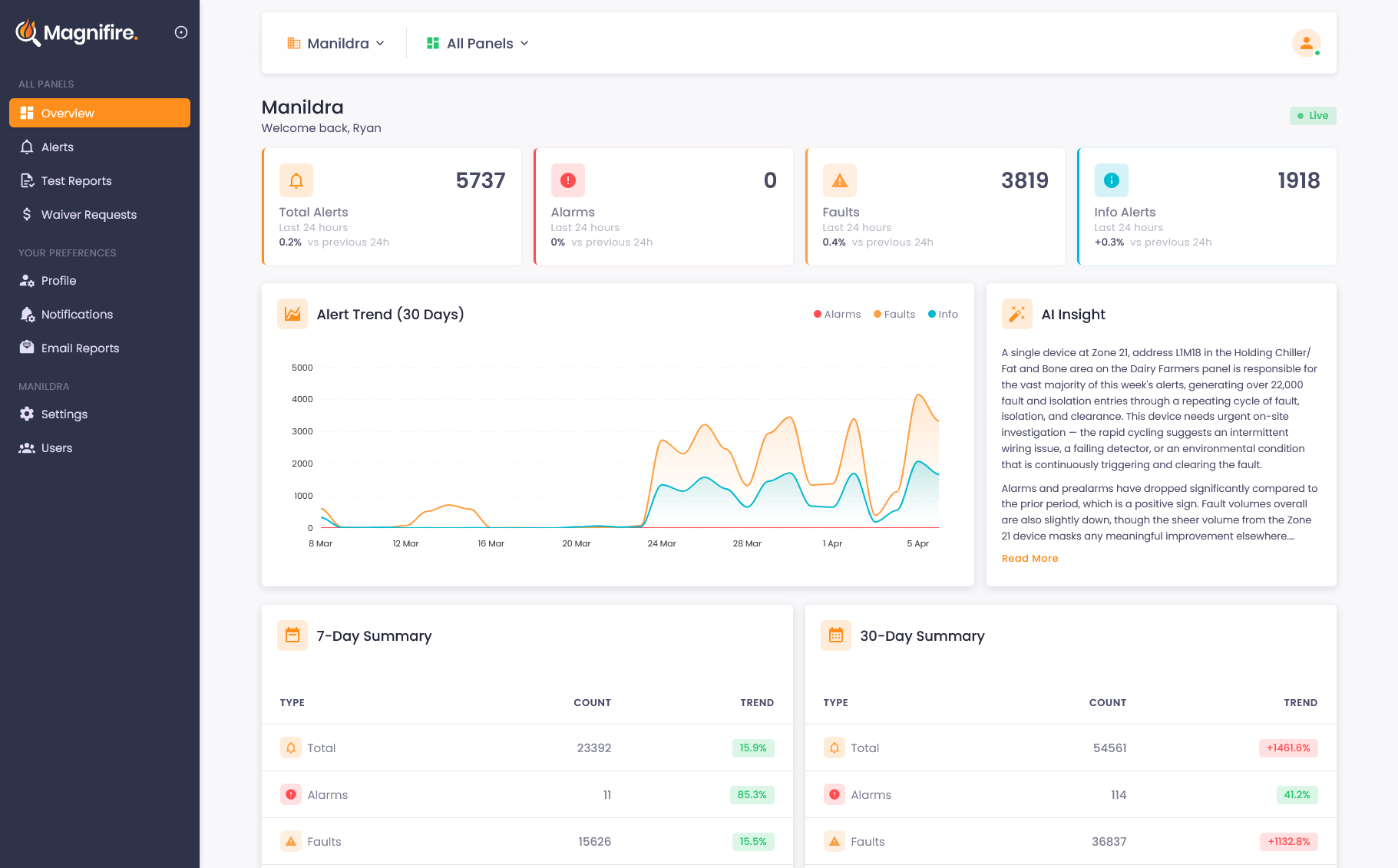
This is the exact problem Magnifire was built to solve. Magnifire connects to your existing fire indicator panel and reads the panel's own event log in real time. When an alarm activates and the brigade is dispatched, Magnifire already knows: which device, which loop, what time, and what happened next.
From there, the waiver process runs on rails instead of memory:
The false alarm is detected and logged the moment it happens, with panel-level data, not a handwritten note from whoever was on site. The deadline countdown starts automatically, tracked against the correct window for your state, so a 180-day NSW clock or a 14-day Victorian submission period never silently expires. The evidence is already assembled, because the panel data showing the activating device and timeline is exactly what a waiver application needs, and it pairs with your rectification records to show the cause was fixed. And the application itself is drafted for you: Magnifire generates a state-specific waiver letter using AI trained on each authority's published guidelines (including FRNSW's Guideline No. 4), with the incident details already populated. You review it, attach your rectification invoice, and submit.
For a portfolio manager, the multi-site dashboard turns this from a per-building scramble into a single view: every alarm, every charge, every waiver deadline, every application status, across all your sites.
Run the numbers on your own building
One recovered charge pays for a lot of monitoring. Two false alarms in a 60-day window is one $1,656 invoice; a building with a recurring detector issue can rack up several before the cause is found. If your building generated even three chargeable false alarms last year and you paid all of them without applying for a waiver, that's potentially thousands of dollars left on the table, from a process that FRNSW itself publishes and invites you to use.
Fifty-eight thousand call-outs a year says false alarms aren't going away. But paying full price for every one of them, with no tracking and no applications, is a choice. And it's one you no longer have to make.
Get in touch and we'll show you the waiver dashboard running on your own building's data.
Sources
- Fire and Rescue NSW: "Automatic Fire Alarms" (~58,000 AFA activations in 2025, ~98% unwanted, ~40% of all responses, $1,656 charge, 60-day and 24-hour leniencies, 180-day waiver window, Commissioner's discretion under s 43)
- Fire and Rescue NSW: Guideline No. 4: Application to Waive AFA False Alarm Charges (AFA-G-04) (waiver criteria, rectification evidence requirements, maintenance records not grounds for waiver, attending officers cannot waive charges)
- Fire and Rescue NSW Act 1989 (NSW): s 42 (charges for false alarm attendance) and s 43 (Commissioner's discretion to waive or reduce charges)
- Fire Rescue Victoria: "False alarms FAQ" (14-day submission period for maintenance records)
See what you've been missing
Whether you own, manage, or maintain fire systems, the visibility changes everything. We'll show you exactly how it works for your situation.