Two things every building manager needs to hear about fire compliance
One is a liability you're probably carrying without knowing it. The other is money you're throwing away every time your fire panel cries wolf.
If you manage a building in Australia, there are two facts hiding in your fire compliance paperwork that could cost you serious money. One is a liability you're probably carrying without knowing it. The other is money you're throwing away every time your fire panel cries wolf. Let's take them one at a time.
1. Your detector testing has minimum percentages, and the liability isn't where you think it is
AS 1851-2012 is the Australian Standard for routine servicing of fire protection systems and equipment. Buried in Section 6 is a requirement most building managers have never read: a minimum percentage of detectors must be physically tested every single year.
For point-type smoke detectors, at least 50% must be functionally tested per annum on each circuit (with real test smoke, in situ), so that every smoke detector in the building is tested over a two-year cycle. For point-type heat detectors, it's 20% per circuit per annum, so that every heat detector is tested over five years. Not a button press at the panel. Not a visual inspection from the floor. A physical activation of the detector itself, recorded, with the alarm verified back at the fire indicator panel.
Here's the part that should make you sit up. In NSW, from 13 February 2026, compliance with AS 1851-2012 became mandatory law for essential fire safety measures in Class 1b and Class 2 to 9 buildings under the Environmental Planning and Assessment (Development Certification and Fire Safety) Regulation 2021. And the legal liability for that compliance sits with the building owner, not the fire contractor who did (or didn't do) the testing.
If you're a building manager, strata manager, or facilities manager signing off on the Annual Fire Safety Statement as the owner's agent, you're in the firing line right alongside them. When a council or Fire and Rescue NSW audit finds the testing wasn't done, the contractor who cut corners isn't the one holding the penalty notice. You are.
What non-compliance actually costs
These aren't parking-ticket numbers. In NSW, fines for failing to comply with the AS 1851-2012 maintenance requirements run to $33,000 for individuals and $66,000 for corporations, figures published by the NSW Building Commission itself. In Victoria, serious essential safety measures breaches prosecuted through the Magistrates' Court (such as ignoring a building order) can attract fines of up to $508,775 for corporations at 2025-26 penalty unit values.
And the fines are only the start. A failed Annual Fire Safety Statement can trigger fire safety orders, rectification costs, and in serious cases, loss of occupancy. If a fire occurs and the maintenance records don't stack up, insurers can reduce or deny claims, and the owner, and their agent, are exposed to civil liability that dwarfs any statutory fine.
The uncomfortable question: how do you know the testing was actually done?
Right now, most building managers sign off on compliance based on two things: a paper logbook and the contractor's word. That's it. That's the entire evidence base standing between you and a $66,000 penalty.
Think about what a logbook actually proves. It proves someone wrote in a logbook. It doesn't prove a technician stood under detector L2-047 with a can of test smoke and watched it fire through to the panel. The overwhelming majority of fire technicians do the right thing, but the record-keeping system gives you no way to tell the difference between a thorough annual service and a signature in a book.
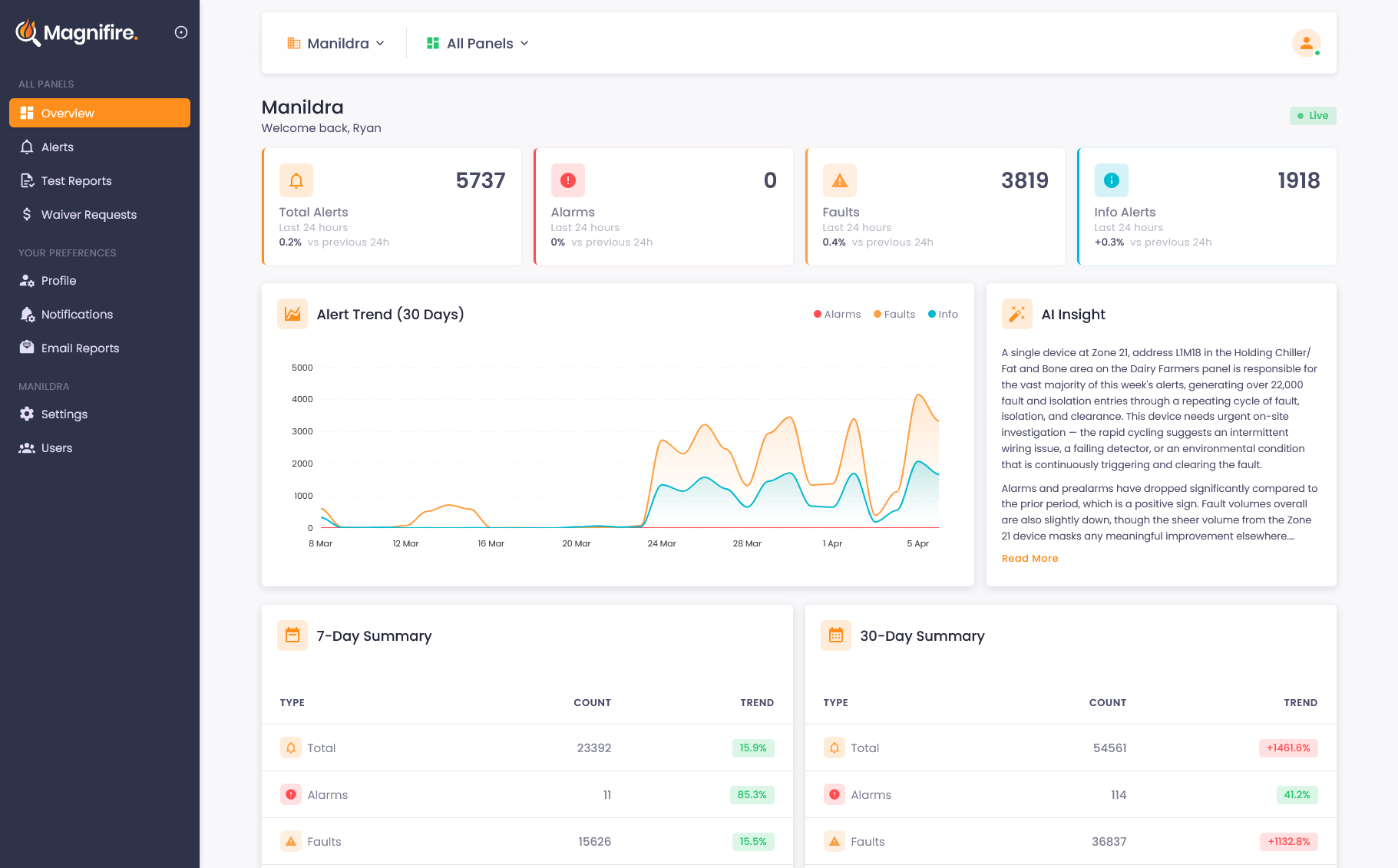
This is where Magnifire changes the equation. Magnifire connects directly to your existing fire indicator panel and captures every event the panel generates, including every detector that actually goes into alarm during testing. The result is an independent, timestamped record of exactly which detectors fired, on which loop, at what time, straight from the panel's own event log. Automatic. Not something anyone can fudge in a logbook after the fact.
When the auditor asks how you know your 50% of smoke detectors were tested this year, you don't hand them a paper book and a hopeful expression. You hand them panel data.
2. You're paying false alarm charges you could be getting waived
Now for the money you're throwing away. Every time your monitored fire alarm system triggers a brigade response to a non-fire event (burnt toast, steam, dust from a tradie's grinder), the fire service charges for it. In NSW, a single false alarm call-out from a monitored automatic fire alarm system costs $1,656. And that's the cheap state. In Victoria, Fire Rescue Victoria charges $657 per truck per 15 minutes, so a multi-appliance response can blow well past the NSW figure before the crews have even packed up.
Fire and Rescue NSW responded to roughly 58,000 automatic fire alarm activations in 2025, and around 98% of them were unwanted alarms. That is an enormous amount of money flowing out of buildings just like yours.
Here's what most building managers don't know: there's a formal waiver process. Every fire authority has one. NSW allows waiver applications up to 180 days from the invoice date, typically where the alarm was beyond your control or where you've rectified the root cause. Queensland gives you 60 days to dispute a charge. But the windows aren't always generous: in Victoria, if FRV asks for your maintenance records, the submission period can be as short as 14 days, and the VCAT appeal window is 28 days from the decision. Miss the window, and the money is simply gone.
Most managers just pay the invoice. They don't know the waiver exists, they don't know the deadline, and even if they did, pulling together the incident details, maintenance evidence, and a properly framed application is a job nobody has time for.
Magnifire does it automatically. The moment your panel registers the false alarm, Magnifire detects it, starts the deadline countdown for your state, and generates a state-specific waiver letter using AI trained on each authority's published guidelines, with the alarm details, the timeline, and the supporting evidence already assembled. All you do is review and submit.
One platform. Real compliance. Recovered money.
Fire compliance shouldn't run on trust and paper. Magnifire gives you independent proof that your detector testing actually happened, and claws back the false alarm charges you're currently writing off. It connects to the fire panel you already have. No rip-and-replace, no disruption to your existing service contractor.
Get in touch and we'll show you the dashboard on your own building.
Sources
- AS 1851-2012: Routine Service of Fire Protection Systems and Equipment, Standards Australia, Section 6 yearly service schedule (smoke detector 50%/2-year and heat detector 20%/5-year functional test cycles). Accessible summary: Extreme Fire Solutions, "Smoke and Heat Detectors"
- NSW Building Commission: "Responsibilities of building owners under AS 1851-2012" (owner liability, 13 February 2026 commencement, $33,000/$66,000 penalties)
- Environmental Planning and Assessment (Development Certification and Fire Safety) Regulation 2021 (NSW): sections 81 and 81A (maintenance duties and penalty units)
- Building Act 1993 (Vic): s 40 (occupation contrary to occupancy permit): 120 penalty units (individual) / 600 penalty units (body corporate); s 118 (contravention of an emergency order or building order): 500 / 2,500 penalty units, or $101,755 / $508,775 at the 2025-26 penalty unit value of $203.51, which is also the maximum fine the Magistrates' Court can impose. See also: Kairos Strategies, "Essential Safety Measures (ESM) Obligations Victoria FAQ"
- Fire and Rescue NSW: "Automatic Fire Alarms" ($1,656 false alarm charge, ~58,000 AFA activations in 2025 with ~98% unwanted, 180-day waiver application window)
- Fire and Rescue NSW: Guideline No. 4: Application to Waive AFA False Alarm Charges (AFA-G-04)
- Fire Rescue Victoria: "Fire alarm systems / False alarms" ($657 per appliance per 15 minutes, 2025/26 rates)
- Fire Rescue Victoria: "False alarms FAQ" (14-day maintenance record submission period; 28-day VCAT appeal window)
- Fire Rescue Victoria Act 1958 (Vic), s 32D: false alarm charges and 28-day VCAT review period
- Queensland Fire Department: "Unwanted alarms charging" (60-day dispute window from invoice date)
See what you've been missing
Whether you own, manage, or maintain fire systems, the visibility changes everything. We'll show you exactly how it works for your situation.